Stanley Spencer, one of our most revered British artists, has attracted the bilious, censorious wrath of the cultural iconoclasts currently supposed to be safeguarding our culture and heritage and been banished to the basement, literally.
In their immense “wisdom,” the curators at the Fitzwilliam Museum, have decided that an art work in their possession, “Love Among the Nations” is racist and ignorant as it depicts people of colour offensively and as caricatures. Much the same reasoning that got Rex Whistler censored and removed from sight. So, a painting that was happily there to be viewed for years on end, is so beyond the pale, that it might cause an outcry or induce a hapless viewer to feel so triggered that they have to be taken to A and E for urgent medical treatment.
“None of Spencer’s human subjects escape this taste for the grotesque, but the painting shows how this broadly misanthropic outlook intersected with unquestioned racism,” they say, claiming with unusual insight to know the mindset of a long dead artist.
Not only has poor Stanley attracted the ire of the “curators” at the Fitzwilliam but also those who profess to be custodians of our culture at the Tate, now infamous for their treatment of another war hero, Rex Whistler. Stanley’s painting titled “Resurrection” in the Tate Britain collection has also suffered the same fate as his painting at the Fitzwilliam and also banished to the basement as the powers that be deem a black figure in the painting “reinforced racist stereotypes and divisions.”
There are no plans to show either of these paintings ever again. The least they could do would be to donate them to the fine little museum devoted to Spencer in his home town of Cookham so they could decide what to do with them. I suppose the iconoclasts who call themselves curators, wouldn’t dare to actually destroy the paintings, so they do the next best thing which is hide them away.
If they had paid attention to what Spencer actually said about the art work himself they might have learned what his intention was. He said: “During the war, when I contemplated the horror of my life and the lives of those with me, I felt the only way to end the ghastly experience would be if everyone suddenly decided to indulge in every degree and form of sexual love, carnal love, bestiality, anything you like to call it. These are the joyful inheritances of mankind.”
As usual, the curators choose to view this painting not as art historians but as graduates with a Critical Race Theory and gender studies certificate, the cancerous movement that dominates every facet of our cultural life and institutions. It’s the same mind set that led to the Cultural Revolution in China and Socialist Realism in Russia. In fact, Spencer had mostly not seen these people of colour and relied on copies of the National Geographic Magazine to inform himself and make the studies.
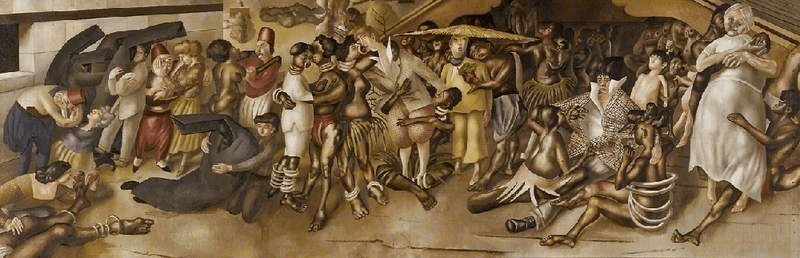
Love Among the Nations @Bridgeman Library all rights reserved. 1935-36.
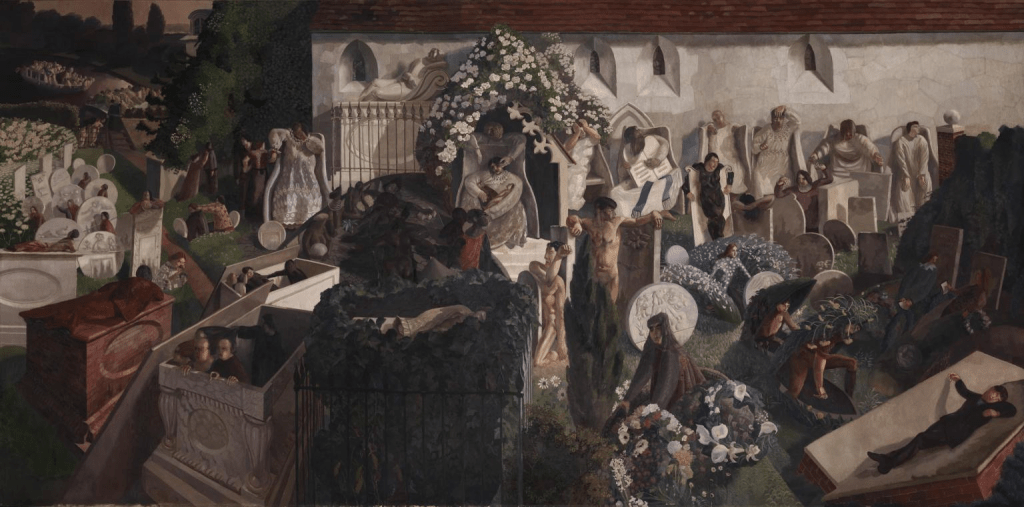
The Resurrection, Tate Britain, copyright @ Tate Britain. 1924.
#Stanley Spencer, #Fitzwilliam Museum, #Tate Britain.
May 2025.
 Art history Unchained.