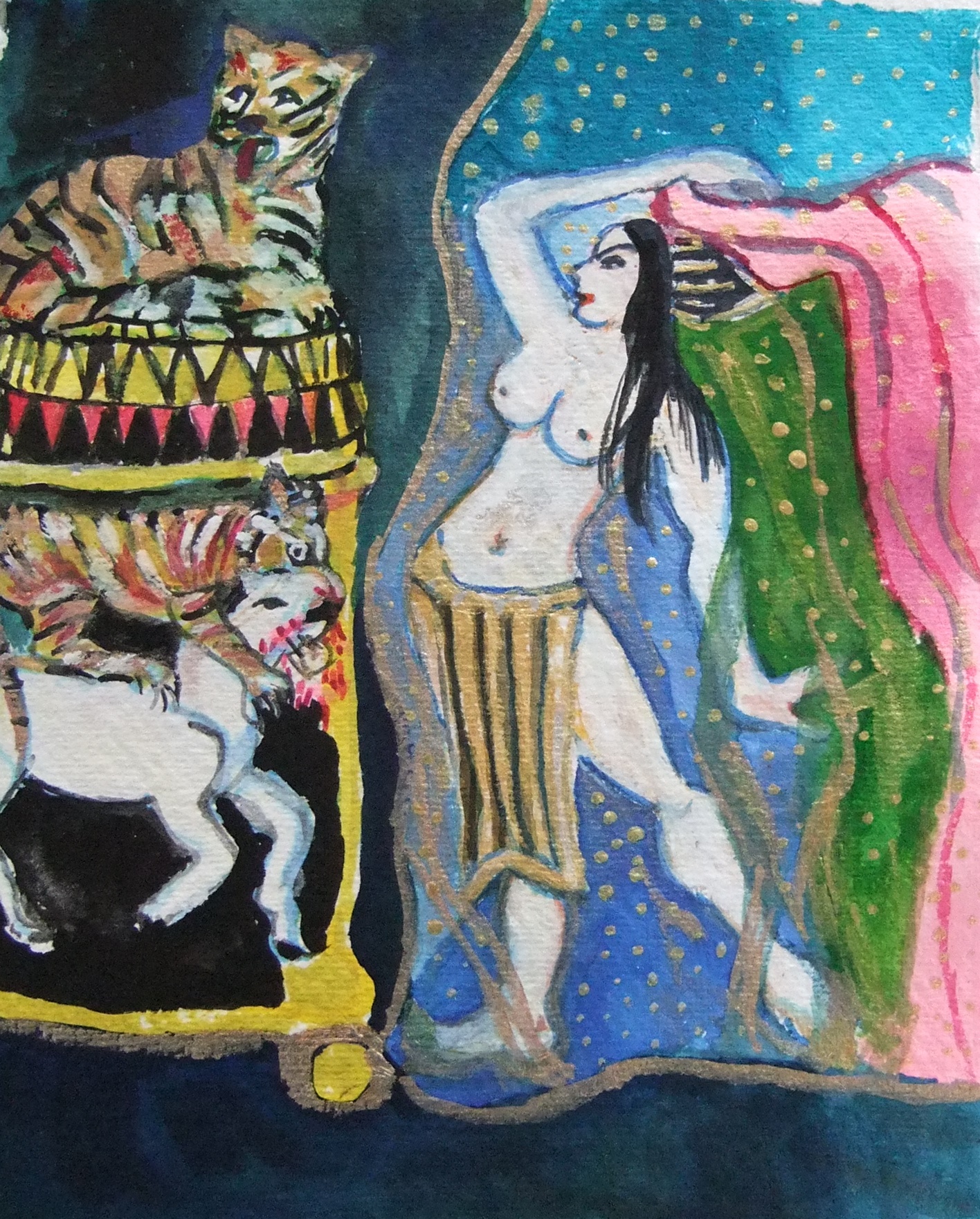
In 1978, Edward Said, wrote a seminal work called “Orientalism” which has influenced post-modern, post-colonial studies in modern University Departments ever since. The main premise of his book was that the West viewed the whole of the East (Asia, North Africa and the Middle East) with contempt. His critique was largely applied to texts but art history departments, never to be outdone, seized upon his work and applied it to nearly all art, particularly the school of Orientalism.
From now on, this school of art was to be viewed only through the narrow prism of post-colonialism and feminism. Thus, a male artist who painted a nude was subjecting women to the “male gaze” and artists who observed and painted scenes and life in the colonies were reinforcing negative, racist stereotypes about their subjects and, thereby, debasing them through “racist pastiches” as Nesrine Malik of the Guardian huffed. There’s no better way to stop enjoying art than to view it through the narrow prism of your own 21st prejudices. There is also another issue. Art is currently under attack. We have seen this before in the various Communist regimes, particularly during the Cultural Revolution under Mao, and other authoritarian regimes such as the Third Reich who deemed many works of art as “degenerate.” It was no fun being an artist who might attract the ire of fundamentalists and it seems we are repeating the same mistakes with what is known as “cancel culture.” How long will it be before the exquisite and accomplished works of art by the Orientalists will have to be moved to places of safety as they are too “offensive” to be put on public view?
There have been two major exhibitions of Orientalist art in the last 10 years: “The Lure of the East” at Tate Britain in 2008 and a more recent one at the British Museum in 2020: “Inspired by the East: how the Islamic world influenced Western Art.” In order to get around sensitivities, both exhibitions carefully labelled most of the works with the correct censorious language derived from the school of Edward Said “right think.” In a Guardian review, Jonathon Jones declared the British Museum exhibition as “the debt Western Art owes to Islam.” Well, no, not really. If anything the debt owed was to the painterly techniques and skills of Renaissance artists which the Orientalists then applied to their observational oil and watercolour paintings of life in the East. In an article published in “Varsity” the author fulminated against the British Museum exhibition, calling it a “cultural crime” and concludes that “the suggestion that we can peacefully absorb Orientalism into the canon of art history is a textbook act of neo-colonialism.” Varsity is a student publication for the privileged children who attend Cambridge University. I assume the author had her smelling salts on hand when she entered the “jarring experience” as she described it, of the exhibition. Imagine being so angry at works of art. It must be a sad existence and certainly not a state of mind I would recommend if you are going to study art.
It is true to say that proponents of the Aesthetic Movement in the UK (1860-80s) took particular inspiration from Oriental interiors. A good example is the the Arab Hall in the London home of artist Frederic Leighton which is now a museum off Kensington High Street and contains his magnificent collection of mosaics brought back from his journeys to the East.

In a reverse turn, while Western liberals eschew Orientalism for being synonymous with “cultural appropriation,” misappropriation and “racist pastiches,” Middle Eastern and Asian collectors are busy acquiring these works of art as a historical record of authentic life in those regions and putting them on display in places like the Islamic Arts Museum in Malaysia. The reason for this, of course, is that Islam does not allow figurative representations. Presumably, they recognise the service these artists provided by detailing and documenting in their paintings the bazaars, interiors, dress, places of worship and everyday life in those countries before photography arrived on the scene. As well as this, they are also works of great beauty.
There are numerous artists associated with this movement but the outstanding ones to my mind are Jean-August Dominique Ingres (1780-1867).

.
Eugene Delacroix (1798-1863).

William Holman Hunt (1827-1910).

Arthur Melville (1855-1904).

John Frederick Lewis (1804-1876.) I will mainly focus on John Frederick Lewis, simply because he is my favourite artist and possibly one of the greatest watercolour artists who ever lived. He deserves an exhibition in his own right in my opinion. John Frederick Lewis, unlike many artists was a private man who didn’t go out of his way to seek fame or attention. He simply got on with his work. His subject matter was interiors, architecture, bazaars, furnishings and tiles painted in rich, vibrant colours and people dressed in native clothing. For his harem paintings, his wife modelled for him and he never painted nudes. The females in the harem scenes he painted were all clothed, unlike the lascivious nudes painted by Ingres. Like many Orientalists, he was fond of dressing up in the local clothing – what today would be described as “cultural appropriation” – and painting self portraits.
The invasion of Egypt by Napoleon in 1798, led to the Eastern world opening up to the French and British. The first people to travel and sketch in those places would have been architects or draughtsmen involved in military or engineering projects. This was how John Frederick Lewis encountered those images for the first time in the form of engravings he saw in London from a set of sketches of Constantinople made by J.R. Coke Smyth (1837). Ingres never actually set foot in the Middle East and worked from other works of art he had seen. John Frederick Lewis, however, decided to travel to the sites of the faraway places that fascinated him. In 1837, he travelled first to Constantinople, after sojourning in Italy and Greece. He then lived in some style in Cairo in a rather grand house for 10 years. He returned to England in 1851 with an outstanding collection of work, including watercolours, oils and sketches made on site. When his watercolour “The Hhareem” was exhibited in 1851, it attracted a great amount of attention and turned him into a successful and sought after artist who was highly influential on other artists. He became an Associate of the Royal Academy in 1859 and was President of the Society of Painters in Water Colours from 1855. He seemed, however, to have found watercolours a frustrating medium despite excelling in it and wanted to focus on oil painting which led to his resignation as President in 1858. After falling out of fashion, his work obtained a new lease of life in the 1970s and his work now fetches millions in auctions. This is unsurprising as it is so superb. Most of all, like the other Orientalists, he left a historical legacy of the life styles and native customs of that period in those countries which, lacking a medium such as photography, was the only way it could have been captured. Far from being condescending, his attitude was respectful and he paints his subjects lovingly and with devotion to detail.


The French are unabashed and unashamed of their history, unlike us, and house probably the most outstanding collection of Orientalist art to be seen anywhere in the unassuming Museum of Narbonne in South West France. Anyone interested in the subject must make it a priority to see the collection there. Visit it if you want a real treat!

@maryrobinson51, July 2020.
References: “The Lure of The East, British Orientalist Painting.” Tate Britain Catalogue, 2008.
 Art history Unchained.