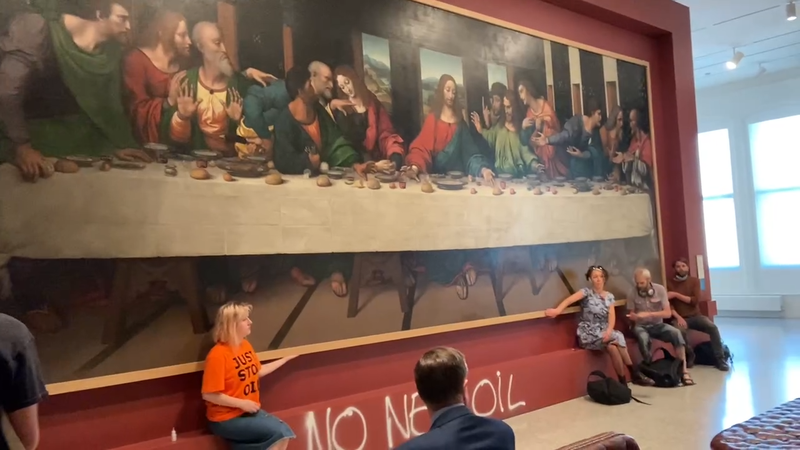
Just Stop Oil protests nearly always involve iconic paintings in public museums, either splashing them with paint or soup or the protesters gluing themselves to the frames. According to their logic, we care more about works of art than we do about the planet. So far, the protests haven’t actually destroyed a work of art, although when the Rokeby Venus in the National Gallery, London, was attacked by hammers and the glass damaged, they came very near to doing so.
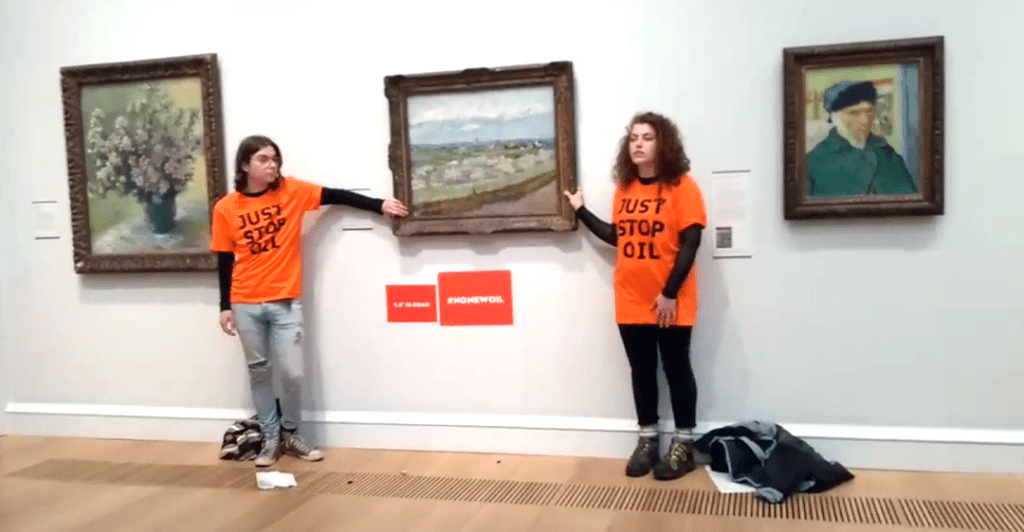
Far from being unimportant, art is now at the forefront of the “Culture Wars.” In the photo above, activists glued themselves to “Van Gogh’s Peach Trees in Blossom” in the Courtauld Gallery. Throwing tomato soup on the same artist’s painting “The Sunflowers” they said: “Vincent lived and died in debt. If he’d been alive today under this government, he would have been one of those people who, this winter would be forced to choose between eating or heating his home.” Regrettably for them, this is not true. If they had bothered to do any research, which they clearly haven’t, they would know that Theo, Vincent’s brother, provided Vincent with a generous allowance which Vincent tended to spend unwisely. He blew money on models, whom he also fed, on his friend Gauguin who took advantage of him and also a fair amount on prostitutes in the brothels he frequented. Booze was also a big problem for Vincent. “Van Gogh and Money” by Liesbeth Heenk” is a detailed account of the financial support Theo gave to Vincent and how crucial this would be. So no, Vincent wouldn’t have starved or frozen as Theo wouldn’t have allowed that to happen. They wasted a tin of soup which could have gone to a food bank!
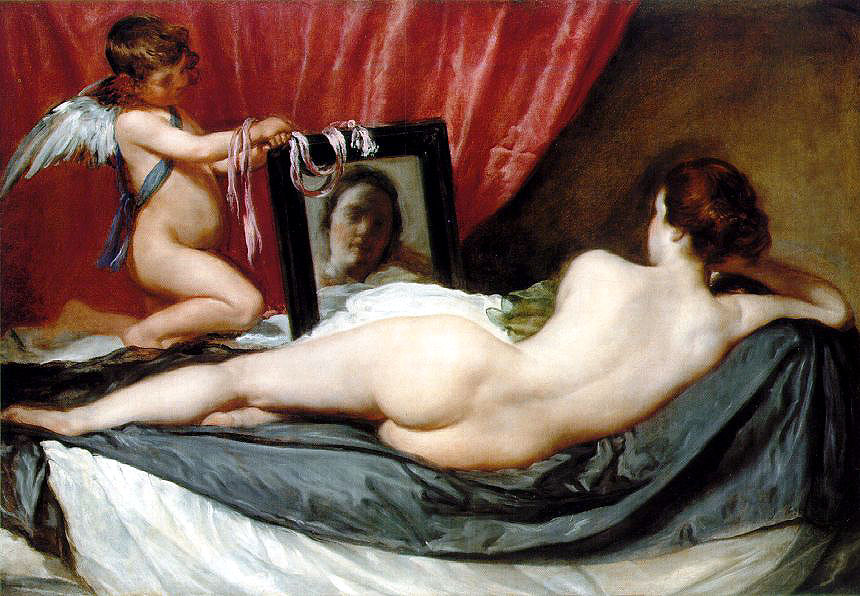
The Rokeby Venus by Velasquez, previously mentioned, was also attacked on a previous occasion back in 1914 when Mary Richardson entered London’s National Gallery armed with a meat cleaver and slashed the Velasquez canvas. Her attack was part of a protest against the imprisonment of Emmeline Pankhurst, the Suffragette. In an interview with Sky News, JSO spokesman Alex de Koning, hinted that they may follow Mary Richardson’s example and actually cause real damage rather than superficial damage to paintings.
Some 92 representatives from cultural institutions across the globe, published an open letter in 2022, decrying these tactics and commented that the activists “severely underestimate the fragility of these irreplaceable objects, which must be preserved as part of our world cultural heritage. As museum directors entrusted with the care of these works, we have been deeply shaken by their risky endangerment.” Incidentally, the frames themselves are historical works of art and there are conservationists who specialise in restoring the frames that surround these paintings. The cost of repairing the frame surrounding the Van Gogh painting “Peach Trees” damaged at the Courtauld, was £2,200, money that museums can ill afford.
The only solution really, is for museums and galleries to beef up their security, doing bag searches and airport style security which obviously makes them less welcoming. This adds additional costs for museums, which have been badly hit by Covid and lockdowns. Our museums in the UK are mostly free so money is always short and museums and galleries have to come up with ever more inventive ways of creating revenue. That is why so many of our free museums hold blockbuster exhibitions to draw in the crowds.
Our art and heritage is in the front line of attacks by left wing activists. Not only Just Stop Oil but academics hired by galleries, specialising in Marxist Critical Race and Feminist Theory whose job it appears is to stir up grievances about the past and create division, acting more like avenging angels than people who are there to preserve our heritage and even behaving as prurient censors should the fancy take them. What makes them think they have the right to remove paintings or objects from public view just in case someone might be offended? The case of the Rex Whistler mural currently closed to the general public in the Tate Britain remains unresolved to this day. Just because 7,000 numpties signed a petition to have it removed.
So what happens if we Just Stop Oil tomorrow? “An end to fossil fuels would have an immediate and significant global impact on poverty, food supply, global products, machinery, plastics, and other aspects of the economy,” writes Tina Olivero in the OGM. “It took 100 years for oil and gas to be integrated into society,” she says. “It will take at least 25 years to remove it responsibly.”
Within a month or so of Just Stop Oil, there would be a catastrophic apocalypse far worse than the scenarios they currently describe from global warming. There are 8 billion people on the planet. How are they fed? By using energy supplied mostly from fossil fuels to create fertilisers and by manufacturing farm machinery and road/rail/shipping/air transport for purposes of distribution. If these forms of transport don’t distribute food, probably about 4 billion would be dead within a month. Only people living remotely with independent resources would survive. Our society has four components on which civilisation is based: concrete, steel, ammonia and plastic which depend heavily on fossil fuel. To make a change requires something dramatic. “We would need to give up cars, live in the woods, live off the land, and give up all of the amenities we enjoy today like cell phones, computers, abundant food sources etc,” writes Tina Olivero. We probably also would be unable to heat and light large museums which hold art works so their doors would close very quickly. If the domestic supply of gas shuts down, that would mean about 74 percent of the population would no longer have heating, hot water or cooking facilities. If these households turned to electricity, power cuts would ensue. No electricity means no mobiles, computers, TV or running water. Hospitals would be unable to run or carry out operations. No power, no heating, no food and no water means people start to die. Riots and civil unrest would break out and disease would spread. The same people who have been criticising Israel for cutting off food and water to Gaza, are quite comfortable about doing the same to us. I’m assuming they have some plot of land somewhere to escape to.
If they are serious, they must provide fully costed and realistic plans about how to reduce our carbon emissions, not just bloviate, block roads and glue themselves to works of art. They should also enlighten us on how an immediate ban on fossil fuels would not create the scenarios described. It is possible of course, to reduce meat eating, fly less, use more public transport, cut down on food and environmental waste and the waste created by the fashion industry and farm more efficiently. I am as keen as they are to preserve natural environments, animal habitats, the ocean, clean water and clean, healthy plant filled urban spaces. I would just like to know how people get their food, energy, water and communications. Answers on a postcard, please.
Image one: Royal Academy, copy of Leonardo da Vinci, The Last Supper, attributed to Giampetrino, c.1515-20. Protest 2022. Wikimedia Commons.
Image two: The Courtauld, Vincent van Gogh’s Peach Trees in Blossom, 1889. Protest 2022. Wikimedia Commons.
Image three: The National Gallery, Velasquez, Rokeby Venus, 1647. Protest 2023. Wikimedia Commons.
February 2024.
 Art history Unchained.